From Polluting Scrap Yards to Clean, Circular Recycling - The Carbasket Vision
Introduction: India’s Hidden Pollution Problem on Four Wheels
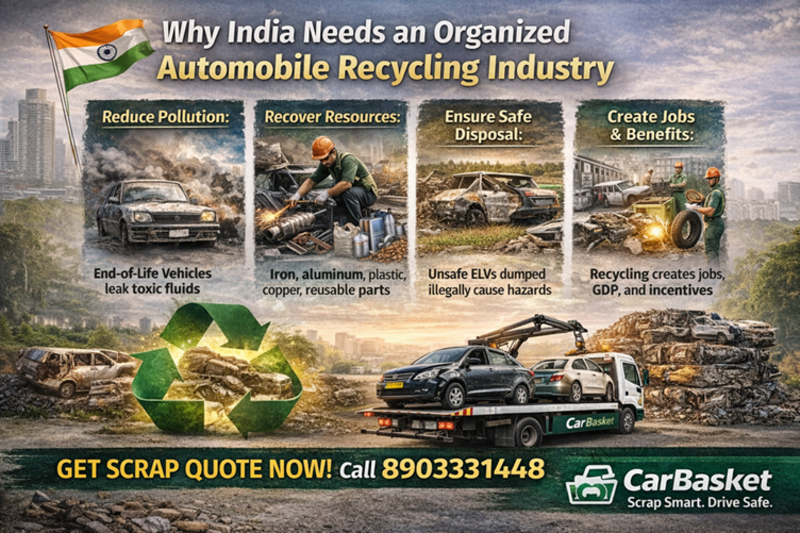
India is one of the largest automobile markets in the world, yet when it comes to automobile recycling, the country still operates largely in an unorganised, unsafe, and highly polluting manner.
Unlike developed economies where End-of-Life Vehicles (ELVs) are recycled through regulated, technology-driven facilities, India’s ELV recycling is dominated by small, informal “mom and pop” scrap shops operating in congested urban pockets.
These informal systems:
- Lack environmental safeguards
- Ignore worker safety
- Pollute soil, water, and air
- Leave vehicle owners legally exposed
Carbasket was founded to change this reality.
The Reality: Unorganised ELV Scrap Markets in Indian Cities
Across Tier-1 cities in India, informal automobile scrap clusters have existed for decades. Some well-known examples include:
Delhi / NCR
- Mayapuri Automotive Junkyard — West Delhi — Historically one of Asia’s largest car recycling clusters, dominated by small dealers dismantling vehicles with little environmental control. Roads & Kingdoms+1
- Various small scrap yards in Bijwasan, Sunder Nagri & Krishna Nagar — Informal dismantlers and metal buyers operating outside regulated scrapping frameworks. Justdial
Mumbai / Maharashtra
- Kurla scrap clusters (informal) — Known locally for cheap auto parts and informal dismantling of old cars. cerorecycling.com
- Borivali & Shahid Tukaram Gopal area — Informal scrap yards dealing in old vehicle metal and parts.
Bengaluru
- Krishnarajapuram / Triveni Nagar areas — Local informal scrap and car parts trading spots with small shops dismantling vehicles.
Pune
- Various small scrap dealers and yards in Narhe Gaon, Pimple Gurav, Dhanori dealing with end-of-life cars and metal parts outside formal recycling systems.
Chennai
- Scrap dealers in Ashok Nagar and surrounding localities — vehicle scrapping done by informal traders rather than regulated facilities.
Ghaziabad & Greater Noida
- Large number of small informal car scrap buyers and yard dealers serving NCR outside official processes.
Other Cities
- Agra, Faridabad, Jodhpur, Thane, Ahmedabad also have scattered unorganised car scrap yards and informal dealers in various local industrial and market pockets
These areas typically operate with:
- Open dismantling on bare ground
- Direct drainage of oils and chemicals
- Burning of plastics and rubber
- No proper RC deregistration
- No pollution control or waste tracking
Why This Is a Serious Problem
A single ELV contains:
- Engine oil, brake oil, coolant, fuel
- Lead-acid or lithium batteries
- AC refrigerant gases (Freon)
- Plastics, rubber, heavy metals
When handled informally, these substances:
- Seep into groundwater
- Release toxic fumes
- Create fire hazards
- Cause long-term environmental damage
This is not recycling - it is pollution transfer.
Why India Needs a Professional Automobile Recycling Industry
In countries like:
- Germany
- Japan
- Netherlands
- South Korea
Automobile recycling is:
- Regulated by law
- Environment-first
- Digitally tracked
- Linked to circular economy goals
India, despite having a national scrappage policy, still lacks ground-level professional execution.
This is the gap Carbasket exists to fill.
Carbasket’s Mission: Build India’s Clean Auto Recycling Backbone
Carbasket is not just a scrapping service.
It is building a structured, compliant, and scalable automobile recycling platform for India.
Our Core Philosophy
Every vehicle deserves a clean and legal end-of-life.
Before any physical dismantling begins, Carbasket ensures full legal compliance, because recycling without documentation is incomplete and risky.
Scrap Your Vehicle Legally with Carbasket
🌐 www.carbasket.in
Carbasket makes vehicle scrapping simple, fast, legal, and eco-friendly. Our end-to-end process is designed to protect vehicle owners while ensuring clean and compliant recycling.
How It Works
- Share Your Vehicle Pictures
- Upload clear photos of your vehicle via our website or WhatsApp.
- Get FREE Scrap Value in Just 5 Minutes
- Our team evaluates your vehicle based on actual scrap metal value, not resale assumptions.
- FREE Pickup Within 2–4 Hours
- Quick doorstep pickup across supported cities—no delays, no hidden charges.
- Spot Payment in 2 Minutes
- Instant payment at pickup via Cash / UPI / Bank Transfer.
- Scrap Letter at the Time of Pickup
- Immediate confirmation that your vehicle has entered the legal scrappage process.
- Scrapping Certificate & Video in 8 Working Days
- Receive official scrappage confirmation and dismantling proof for complete peace of mind.
Documents Required
- RC (Xerox copy)
- Owner ID proof (Xerox copy)
- 👉 No complex paperwork. No unnecessary documents.
Get Your FREE Quotation Now
Award-Winning Clean Recycling
🏆 Recycling Clean & Green Award Winner: 👉 https://www.carbasket.in/scrap-vehicle-images
Step 1: Legal Compliance Before Physical Scrapping
Before an ELV enters the recycling stream, Carbasket conducts:
- RC verification & status check
- Challan and blacklist checks
- Hypothecation / ownership validation
- Guidance on RC deregistration
This ensures:
- The vehicle is legally eligible
- The owner is protected from future liability
- The ELV is formally exited from the system
Only after this step does physical processing begin.
Step 2: De-Pollution – The Most Critical Stage
De-pollution is almost entirely ignored in unorganised scrap yards.
At Carbasket, it is the first and most important step.
What De-Pollution Includes
- Removal of battery
- Draining of engine oil, brake oil, transmission oil
- Removal of fuel & coolant
- Safe extraction of AC refrigerant (Freon gas)
All materials are:
- Collected in separate, sealed containers
- Labelled and stored safely
- Sent only to authorised downstream handlers
This step alone prevents massive soil and air contamination.
Step 3: Dismantling – Reuse Before Recycling
Not all vehicle components are waste.
During dismantling:
- Reusable parts are carefully removed
- Each part undergoes quality inspection
- Components are catalogued and documented
This reduces:
- Demand for new manufacturing
- Resource extraction
- Carbon footprint
Reuse is always more sustainable than recycling.
Step 4: Scrapping & Material Segregation
After dismantling, the remaining shell undergoes controlled scrapping.
What Happens Here
- Unusable parts are cut or shredded
- Materials are segregated into:
- Steel
- Aluminium
- Copper
- Rubber
- Plastics
- Fabric
Unlike informal yards, nothing is mixed or burnt.
Step 5: Recycling Through Industrial Supply Chains
Segregated scrap is sent to:
- Steel mills
- Plastic recycling units
- Rubber processing factories
Here, it becomes raw material for new products:
- Steel sheets
- Plastic moulds
- Rubber components
This is true circular economy recycling.
Step 6: Liquid Recovery & Refining
All collected liquids:
- Engine oil
- Gear oil
- Coolant
Are sent to authorised refineries, where they are:
- Filtered
- Reprocessed
- Reused
This ensures:
- Minimal waste generation
- Maximum resource recovery
Carbasket’s Vision: Lead India’s Auto Recycling Revolution
India is entering a phase where:
- Vehicle ownership is exploding
- Old vehicles are being phased out
- EVs are entering the lifecycle
Without organised recycling, pollution simply shifts location.
Carbasket aims to:
- Become India’s most trusted automobile recycling platform
- Set benchmarks for clean ELV disposal
- Align India with global recycling standards
- Protect vehicle owners legally and environmentally
FAQs - Automobile Recycling in India
1. Is automobile recycling organised in India?
No. Most recycling still happens in informal, unregulated scrap yards.
2. Why are informal scrap yards harmful?
They pollute soil, air, and water, and pose safety and legal risks.
3. What is de-pollution in vehicle recycling?
It is the safe removal of oils, fluids, batteries, and gases before dismantling.
4. Does Carbasket ensure RC deregistration?
Yes. Legal compliance is a mandatory first step.
5. What happens to scrapped vehicle materials?
They are recycled into raw materials for new products.
6. How does Carbasket help the environment?
By preventing pollution, enabling reuse, and supporting circular economy recycling.
Final Thought: Recycling Is Not Just Scrapping
Scrapping without standards is pollution.
Recycling with responsibility is progress.
Carbasket is building the future of clean automobile recycling in India.
Scrap legally.
Recycle responsibly.
Drive a cleaner future with Carbasket.